

Types of Door Locks in Dubai: Which Is Right for Your Home?
Choosing a door lock is not simply about finding the strongest-looking or most expensive product. Different doors use different locking systems, and a lock that works well on a wooden apartment entrance may not be suitable for an aluminum, glass, or sliding door.
Understanding the main types of door locks can help you identify the hardware already fitted to your property and make a better decision when a lock needs to be repaired, changed or upgraded.
Some doors use a separate cylinder and lock body. Others have a mortise mechanism, deadbolt or multiple locking points. Smart locks add electronic access methods such as PIN codes, fingerprints, cards or mobile apps.
The right choice depends on the door, existing hardware, access requirements, and how the property is used.
In this guide, we'll explain the common types of door locks in Dubai, how they work, where they are typically used, and what you should consider before choosing one.
Choosing a door lock is not simply about finding the strongest-looking or most expensive product. Different doors use different locking systems, and a lock that works well on a wooden apartment entrance may not be suitable for an aluminium, glass or sliding door.
Understanding the main types of door locks can help you identify the hardware already fitted to your property and make a better decision when a lock needs to be repaired, changed or upgraded.
Some doors use a separate cylinder and lock body. Others have a mortise mechanism, deadbolt or multiple locking points. Smart locks add electronic access methods such as PIN codes, fingerprints, cards or mobile apps.
The right choice depends on the door, existing hardware, access requirements and how the property is used.
In this guide, we'll explain the common types of door locks in Dubai, how they work, where they are typically used and what you should consider before choosing one.
What Are the Main Types of Door Locks?
Here is a quick comparison before we look at each type in more detail:
These categories are useful for understanding door hardware, but they are not always completely separate.
For example, a door can have a mortise lock that operates using a Euro-profile cylinder. A smart lock may also work with an existing mortise mechanism.
That is why identifying the complete locking system is more useful than looking at a single component.
1. Cylinder Locks
A cylinder is the part of many mechanical locks where the key is inserted.
When the correct key is turned, the cylinder operates the associated locking mechanism.
One important point is that the cylinder is not necessarily the complete door lock. It may work together with a mortise lock, deadlock, or another locking mechanism installed inside the door.
Common Cylinder Configurations
Depending on the system, you may encounter:
Double cylinder: Key operation is provided from both sides.
Single cylinder: The key operation is provided on one side, with a different arrangement on the other.
Cylinder with thumb turn: The exterior may be operated with a key, while the interior can be operated with a thumb turn.
The exact configuration suitable for a door depends on the hardware and access requirements.
Euro-Profile Cylinders
Euro-profile cylinders have a recognizable profile and are used with compatible locking systems.
They are available in different:
- Lengths
- Configurations
- Key systems
- Security specifications
- Finishes
When replacing one, dimensions matter. A cylinder should be selected based on the lock and door, rather than simply choosing one that looks similar.
If the existing lock body is functioning correctly but you want the previous keys to stop working, changing the appropriate cylinder may sometimes be sufficient, rather than replacing the entire lock.
2. Mortise Locks
A mortise lock has its main lock body installed inside a pocket, or mortise, cut into the edge of the door.
From the outside, you may see only the handle, cylinder, or keyway and associated trim, while much of the actual mechanism sits inside the door.
Mortise locks can incorporate different combinations of:
- Latch
- Deadbolt
- Handle operation
- Cylinder
- Lever mechanism
They are used on various residential and commercial doors.
Because mortise locks come in different dimensions and configurations, replacement is not simply a matter of choosing another mortise lock.
Measurements such as the lock case, backset, and existing door preparation can affect compatibility.
3. Deadbolt Locks
A deadbolt uses a bolt that extends into the door frame when locked.
Unlike a spring latch that can move when the door closes, a deadbolt is intentionally extended and retracted through its operating mechanism.
Deadbolts can be used as a primary or additional locking mechanism depending on the door.
Different configurations are available, and their suitability depends on factors such as:
- Door construction
- Frame
- Existing hardware
- Cylinder arrangement
- Intended use
A deadbolt should therefore be considered as part of the complete door setup rather than judged in isolation.
4. Rim Locks and Night Latches
A rim lock is mounted primarily on the surface of the door rather than recessed deeply into it, as with a mortise lock.
A night latch is a familiar example of surface-mounted locking hardware.
These systems typically include a lock body on the interior side of the door and compatible external key-operated hardware.
They are structurally different from mortise locks, which makes identification important when ordering replacement parts or planning a door lock change in Dubai.
5. Multipoint Locking Systems
A multipoint lock operates several locking points along the edge of a door.
Instead of relying on a single locking point, one operation can engage multiple points in the frame.
Depending on the system, these may include combinations of:
- Bolts
- Hooks
- Rollers
- Other locking elements
Multipoint systems are often integrated into the door rather than installed as a simple standalone lock.
If a problem develops, the fault may involve the cylinder, handle, gearbox, alignment, or another part of the mechanism.
This is one reason why correctly diagnosing the existing system matters before replacing components.
6. Sliding-Door Locks
Sliding doors require locking mechanisms designed around horizontal movement rather than the operation of a conventional hinged door.
Depending on the door, a sliding lock may use:
- Hook-style locking mechanisms
- Latches
- Key-operated cylinders
- Handles with integrated locking components
- Multipoint arrangements
Door alignment is particularly important.
If a sliding door no longer closes to the correct position, the locking mechanism may appear faulty even when the problem lies in the door's alignment or movement.
If the mechanism itself is damaged or no longer operating correctly, professional sliding door lock repair may be appropriate, but the door's alignment and movement should also be checked before replacing hardware.
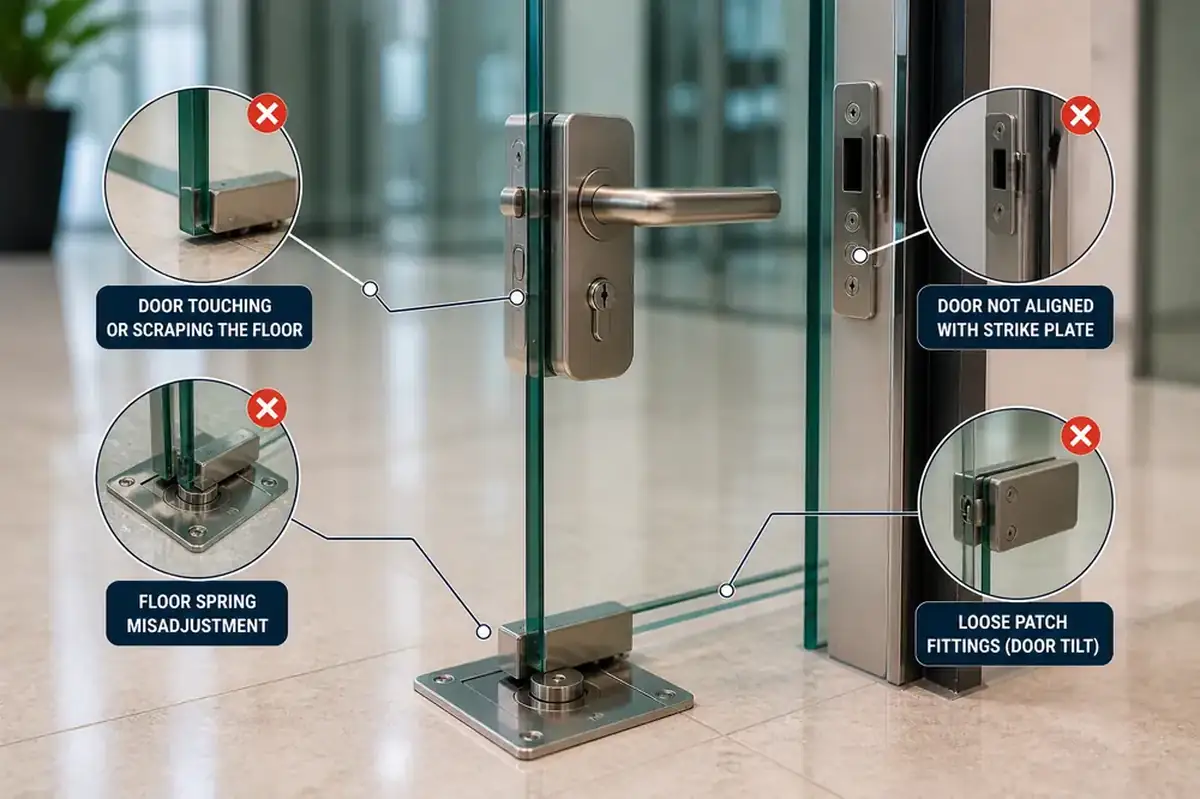
7. Glass-Door Locks
Glass doors require hardware compatible with the door's construction.
Depending on the installation, a glass door may use specialized:
- Patch locks
- Floor locks
- Deadbolts
- Cylinders
- Electronic locking components
The correct hardware depends on the glass-door system and existing preparation.
A conventional lock designed for a wooden door cannot simply be assumed to be appropriate for a glass door.
If a glass-door lock develops a problem, identify the existing hardware and door configuration before selecting a replacement.
8. Smart Door Locks
A smart door lock uses electronic controls to provide one or more access methods.
Depending on the model, these may include:
- PIN code
- Fingerprint
- Access card
- Key fob
- Mobile application
- Bluetooth
- Wi-Fi or another connected function
- Mechanical key override
Not every smart lock provides all of these features.
Likewise, a smart lock is not automatically suitable for every door.
Before considering smart lock installation in Dubai, check compatibility with the existing:
- Door material
- Door thickness
- Mortise or lock body
- Backset
- Handle arrangement
- Opening direction
- Existing cut-outs
The electronic features may attract the most attention, but mechanical compatibility is equally important.
9. Electronic and Access-Control Locks
Not every electronically controlled lock is a consumer smart lock.
Commercial properties, offices, and controlled-access areas may use electronic locking hardware as part of an access control system installation.
Depending on the system, access may be managed through:
- Cards
- Key fobs
- PINs
- Biometrics
- Mobile credentials
- Central access-control software
The locking hardware and access-control system perform related but different functions.
The access-control system determines whether access is authorized, while compatible locking hardware physically controls the door.
The appropriate setup depends on the door, property requirements, and required access levels.
10. Padlocks
Padlocks are portable locks, not permanently integrated door locks.
They are commonly used with compatible hasps, chains, gates, cabinets, storage units, and other applications.
There are many different types of padlocks, including:
- Key-operated padlocks
- Combination padlocks
- Weather-resistant models
- Different shackle configurations
Padlocks vary considerably in construction and intended use.
A lightweight padlock designed for a cabinet should not be directly compared with hardware intended for a gate or another more demanding application.
The padlock and whatever it attaches to should be considered together.
Is a Door-Lock Cylinder the Same as a Door Lock?
No, not necessarily.
This is one of the most common areas of confusion when discussing door lock types.
In many locking systems:
The cylinder is the component into which the key is inserted.
The lock body contains the mechanism that operates the latch, bolt or other locking components.
For example, a mortise lock may use a replaceable Euro-profile cylinder.
If you lose control of the existing keys but the mortise mechanism is still functioning correctly, it may be possible to change the cylinder without replacing the entire mortise lock.
On the other hand, if the internal mechanism itself is damaged, changing only the cylinder may not solve the problem.
This distinction can make a significant difference when deciding whether to repair or replace door hardware.
How Do You Identify the Type of Door Lock You Have?
If you don't know what type of lock is fitted to your door, don't rely only on the appearance of the key.
Look at the complete door.
Check the Front of the Door
Look at:
- Keyway or cylinder
- Handle
- Knob
- Electronic keypad
- Fingerprint reader
- Visible lock hardware
Check the Inside
The interior can reveal:
- Thumb turns
- Surface-mounted lock bodies
- Smart-lock components
- Handles
- Additional deadbolts
Check the Door Edge
Open the door and look at the edge.
You may see:
- Latch
- Deadbolt
- Mortise faceplate
- Hook
- Multiple locking points
- Manufacturer markings
Check for a Brand or Model
Manufacturer markings can help identify compatible parts.
If you're requesting a quote for a repair or replacement, clear photos of the outside, inside, and edge of the door can provide much more useful information than a photo of the key alone.
Which Type of Door Lock Is Right for Your Door?
There isn't one door lock that is automatically best for every property.
Start with the type of door.
Apartment Entrance Doors
Apartment entrance doors may use mortise locks, cylinders, multipoint mechanisms, or other configurations depending on the building and door.
Before replacing anything, identify the existing system.
If the objective is simply to prevent old keys from operating the door, it may not always be necessary to replace every component.
This is particularly worth considering when moving into a new home, where the existing lock may be functioning correctly but you may not know how many copies of the previous keys were made.
Villa Entrance Doors
Villa entrance doors can vary significantly in size, material, and construction.
Consider the complete setup:
- Door
- Frame
- Existing lock
- Cylinder
- Handles
- Additional locking points
- Access requirements
For larger or custom doors, compatibility becomes particularly important.
Wooden Doors
Wooden doors can accommodate various locking systems depending on their thickness, construction and existing preparation.
These may include mortise locks, cylinders, deadbolts and other arrangements.
If the door has already been prepared for a particular lock body, choosing compatible replacement hardware can reduce unnecessary modification.
Aluminium Doors
Aluminum doors often use hardware designed to match the door's dimensions and profile.
When replacing a lock, check the existing mechanism and measurements rather than assuming that a standard residential lock will fit.
Glass Doors
Use hardware designed for the specific glass-door configuration.
The type of glass, fittings, and existing preparation can affect what can be installed.
Sliding and Patio Doors
Sliding doors require hardware that accommodates the door's movement and closing position.
If the lock has become difficult to operate, check the alignment, door movement, and the locking mechanism.
Mechanical Lock or Smart Lock?
Choosing between a traditional mechanical lock and a smart lock depends on what you want from the door.
A mechanical system may suit someone who wants straightforward key-based operation.
A smart lock may be useful when electronic access features are important, such as:
- Multiple user codes
- Fingerprint access
- Temporary access
- Card access
- App-based features
However, the decision should not be based only on features.
Also consider:
- Door compatibility
- Power requirements
- Battery maintenance
- User management
- Mechanical override options
- Availability of compatible replacement parts
- How the property will be used
For some properties, retaining a suitable mechanical system is entirely appropriate. For others, electronic access may provide useful functionality.
Should You Repair or Replace Your Existing Door Lock?
A faulty lock does not necessarily need to be replaced.
Some problems can be related to:
- Door alignment
- Loose hardware
- Strike plate position
- Handle mechanism
- Cylinder
- Latch
- Internal lock components
In those situations, door lock repair may be sufficient.
Replacement becomes more relevant when:
- Hardware is badly damaged
- Important components are worn
- Compatible parts are unavailable
- Existing keys should no longer operate the lock
- The existing system no longer suits the property
- You are intentionally upgrading the locking system
The first step should therefore be identifying the actual fault.
Do You Need to Replace the Whole Lock After Losing a Key?
Not always.
If the concern is that a lost key could still operate the door, the appropriate solution depends on the locking system.
With some locks, it may be possible to:
- Rekey compatible hardware
- Change the cylinder
- Change part of the locking system
A complete lock replacement may not be necessary if the remaining hardware is in good condition and compatible with the chosen solution.
This is another reason why knowing what type of lock you have matters.
What Should You Consider Before Choosing a New Door Lock?
Rather than choosing a product only because of its brand, appearance, or features, consider the complete installation.
Door Compatibility
The lock must be compatible with the door's material, dimensions, and construction.
Existing Preparation
Replacing an existing lock with compatible hardware may be more straightforward than modifying the door for a completely different system.
Access Requirements
Consider who needs access and how they should enter.
A family home, rental property, office, and restricted commercial area may have very different requirements.
Mechanical or Electronic Access
Decide whether conventional keys are sufficient or whether electronic credentials provide useful functionality.
Key Control
Consider how many people require keys and how spare keys will be managed.
Maintenance
Mechanical and electronic locks have different maintenance considerations.
Smart locks, for example, may require battery management in addition to normal mechanical maintenance.
Repairability and Parts
Consider whether suitable parts and service support are available for the chosen system.
Which Door Lock Is the Most Secure?
There isn't a meaningful universal answer based solely on the lock category.
It would be misleading to say:
Smart locks are always more secure than mechanical locks.
or:
Multipoint locks are always more secure than cylinder locks.
These are different components and systems.
The overall security of an entrance can depend on:
- Lock construction
- Cylinder
- Door
- Frame
- Strike or locking points
- Installation
- Key or credential control
- Condition of the hardware
A well-made lock fitted incorrectly to an unsuitable door can perform differently from the same hardware installed as intended.
For this reason, compare complete locking arrangements rather than judging security from the product category alone.
Frequently Asked Questions About Types of Door Locks
What Are the Most Common Types of Door Locks?
Common categories include cylinder locks, mortise locks, deadbolts, rim locks, multipoint systems, sliding-door locks, glass-door locks and smart locks.
The types found on a particular property depend on the doors and the building's configuration.
What Type of Door Lock Do I Have?
Check the outside and inside of the door, as well as the edge of the door.
The cylinder shape, faceplate, latch, bolt, number of locking points, and manufacturer markings can help identify the system.
What Is the Difference Between a Cylinder and a Mortise Lock?
A cylinder is typically the key-operated component.
A mortise lock refers to a lock body installed within a recess in the door.
A mortise lock can use a separate cylinder, meaning both components may form part of the same locking system.
Can I Replace Only the Cylinder?
Sometimes.
If the existing lock mechanism is functioning correctly and uses a replaceable cylinder, changing the appropriate cylinder may be sufficient.
Compatibility and dimensions need to be checked first.
What Type of Lock Is Suitable for a Sliding Door?
Sliding doors use locking mechanisms designed for sliding operation. Depending on the door, these can include hook-style locks, integrated handle locks and multipoint mechanisms.
The existing door configuration should be identified before choosing replacement hardware.
Can I Install a Smart Lock on Any Door?
Not necessarily.
Smart-lock compatibility can depend on door material, thickness, existing mortise, backset, handle arrangement, opening direction and other dimensions.
Check compatibility before selecting a smart lock.
Should I Replace a Lock That Is Difficult to Turn?
Not automatically.
A stiff lock can be caused by the cylinder or internal mechanism, but door alignment and other hardware can also contribute.
Have the cause identified before deciding between repair and replacement.
Do I Need a Complete New Lock If I Lose My Keys?
Not in every case.
Depending on the system, changing or rekeying the appropriate cylinder may prevent the old key from operating the door without replacing every part of the lock.
Need Help Choosing or Changing a Door Lock?
Understanding the different types of door locks makes it easier to decide what your door actually needs.
The important question isn't simply:
“Which lock is best?”
Instead, consider:
“Which lock is appropriate for this door and the way I need to use it?”
Start by identifying the existing lock, door material and access requirements. If something is faulty, determine whether the problem involves the cylinder, lock mechanism, door alignment or another component before replacing hardware unnecessarily.
DEX Key Maker provides door lock assessment, repair and door lock change in Dubai for residential and commercial doors. Clear photos of the outside, inside, and edge of the door can help identify the existing hardware before the appropriate repair or replacement option is determined.



.png)