
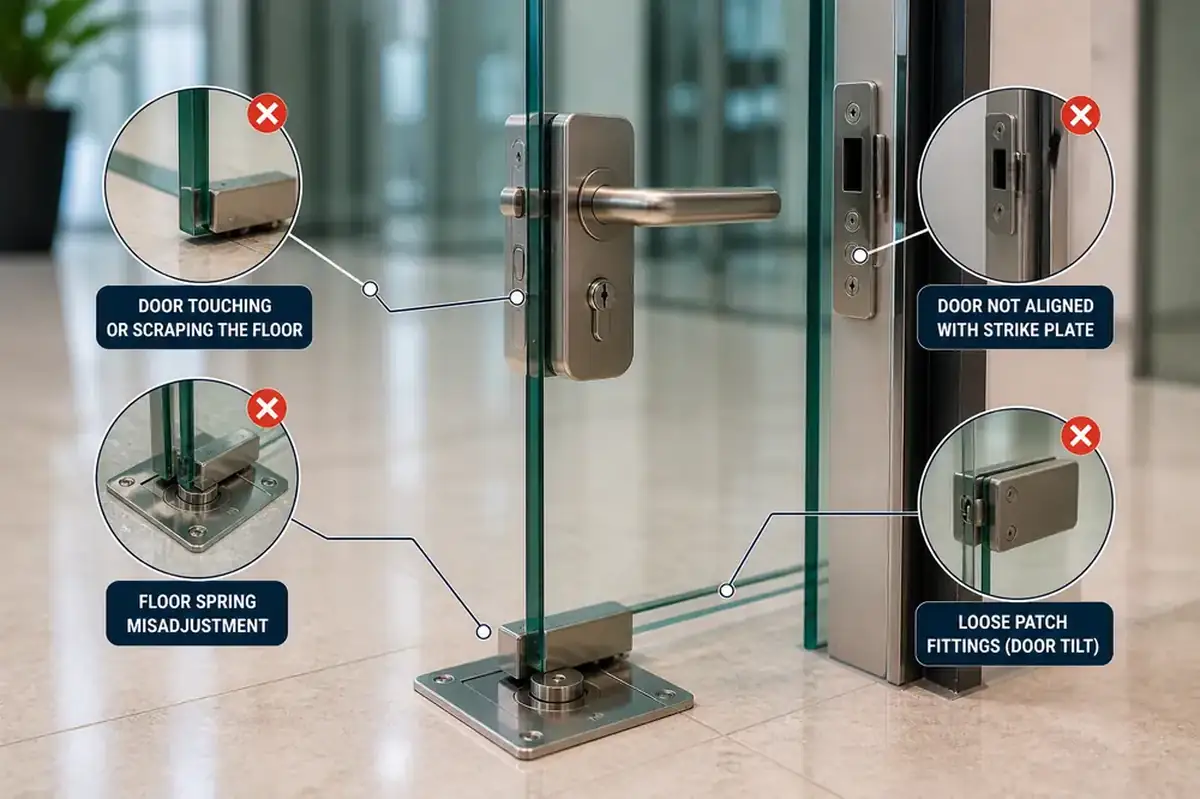
Glass Door Not Closing Properly? Lock Replacement vs Door Alignment
If your glass door is not closing properly, feels difficult to lock, or has started touching the floor, don't immediately assume the lock needs replacing. The problem may come from the lock itself, but it can also be related to the door's alignment, patch fittings, floor spring, or the position where the lock meets the strike. Identifying the cause first can help determine whether you need an adjustment, lock repair, or a door lock change.
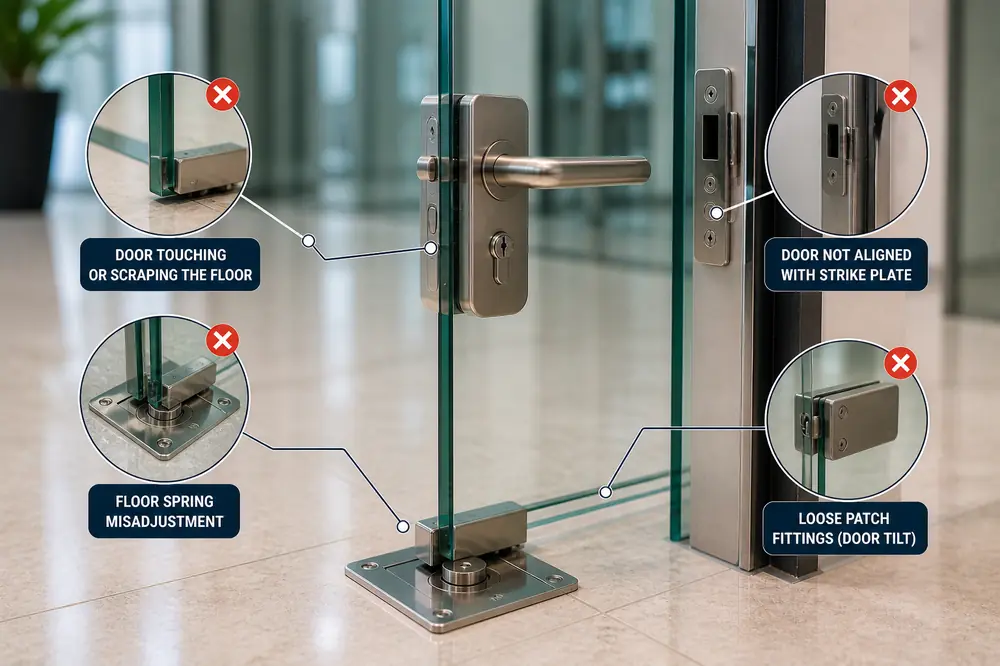
Glass doors rely on several components working together. Even when the lock itself is operating normally, a change in the door's position can prevent the locking points from lining up correctly. That is why checking the door and lock together is important before replacing any hardware.
Why a Glass Door Can Look Like It Has a Lock Problem
When a glass door becomes difficult to close, requires extra pressure to lock, or suddenly refuses to lock altogether, the lock is an obvious place to look.
But the lock is only one part of the system.
For the door to lock correctly, the locking mechanism needs to meet its corresponding strike or locking point in the correct position. If the door has shifted, the two may no longer line up properly.
In that situation, replacing the lock without correcting the alignment may leave you with exactly the same problem.
The Problem May Be Glass Door Alignment
Door alignment describes how the glass door sits and moves relative to its frame, fittings, and locking points.
When everything is positioned correctly, the lock and strike should meet as intended. If the door's position changes, even a functioning lock may become difficult to engage.
There are several parts of a glass-door installation that may be worth checking.
1. The Door Has Changed Position
Glass doors can be heavy, and their position depends on the hardware that supports and controls them.
If the door starts sitting lower or differently than before, you may notice that it touches the floor, the gaps around it look different, or the lock no longer lines up as it previously did.
This doesn't automatically mean that the lock itself has failed.
2. Patch Fittings Need Attention
Frameless glass doors commonly use metal patch fittings to connect and support the glass within the door system.
If the positions of these fittings change, the door's position can change accordingly. Even a relatively small difference can affect how the lock meets its corresponding locking point.
The fittings and door position should therefore be checked as part of the diagnosis.
3. The Floor Spring May Be Involved
Many glass doors use a floor spring to control their movement and closing action.
If the door is no longer returning consistently to its intended closed position, the floor spring or its relationship with the rest of the door hardware may need to be inspected.
A door that stops slightly short of its normal position can make a perfectly ordinary locking action feel like a lock problem.
4. The Lock and Strike Are No Longer Lining Up
Sometimes the most noticeable symptom is simple: the lock operates, but the bolt or locking point doesn't meet the strike correctly when the door is closed.
That can indicate an alignment issue, although the complete door and lock should be checked before drawing a conclusion.
Signs the Problem May Be Door Alignment
Certain symptoms may suggest that the door's position should be checked before deciding whether to replace the glass door lock.
Look for things such as:
- The glass door touching or scraping the floor
- A gap around the door that appears different from before
- The door not consistently returning to the same closed position
- The lock and strike no longer lining up correctly
- The locking behavior changing depending on the position of the door
These signs don't prove that the lock is fault-free. They simply indicate that alignment should be part of the inspection.
A glass door can also have multiple problems at the same time, which is another reason not to diagnose it based on a single symptom.
When Lock Repair or Replacement May Be Needed
Not every glass-door problem is caused by alignment.
The lock itself may need attention if the mechanism, cylinder, handle, or related hardware is damaged or no longer operating correctly.
Signs worth having checked include:
- The key remains difficult to turn even when the door is correctly positioned
- The cylinder does not operate normally
- There is visible physical damage to the lock or handle
- The locking mechanism does not operate correctly independently of the door position
- A component of the lock is broken or excessively worn
The condition of the existing hardware should determine whether repairing the glass door lock is practical or replacing it is the more appropriate option.
Don't replace the lock simply because the door doesn't lock. First establish why it doesn't lock.
Glass Door Alignment vs Lock Repair
The symptoms can sometimes provide useful clues, but they should be treated as a starting point rather than a final diagnosis.
The important distinction is that alignment problems and lock problems require different solutions.
Why Diagnosis Matters Before Lock Replacement
Replacing a lock won't correct a glass door that's out of position.
If misalignment is causing the lock and strike to meet incorrectly, installing another lock without addressing the door position may leave the underlying problem unresolved.
The opposite is also true. Repeatedly adjusting a door won't solve an internal lock mechanism that has genuinely failed.
A proper inspection should therefore answer two questions:
Is the door positioned correctly?
and
Is the lock operating correctly?
Once those are established, it becomes much easier to decide whether adjustment, repair or replacement is appropriate.
What Happens During a Glass Door Inspection?
The exact inspection depends on the door and hardware, but a technician may need to check several areas rather than just the lock.
These can include the door position, upper and lower fittings, floor spring, lock operation and the way the lock meets the strike or corresponding locking point.
The objective is to identify where the problem originates.
If the door position is responsible, the appropriate hardware or alignment can be addressed. If the lock itself is faulty, its condition can then be assessed to determine whether repair or replacement is suitable.
The amount of work required depends on the door, hardware, and actual fault, so it is better to diagnose the problem before estimating the repair required.
Can Misalignment Eventually Affect the Lock?
A door and lock that repeatedly meet in the wrong position can place unnecessary stress on the components involved.
For example, if the locking bolt repeatedly contacts the edge of the strike rather than entering normally, the cause should be investigated rather than continually forcing the lock.
The same applies when a glass door is scraping against another surface.
Continuing to force a door or lock that is no longer operating normally can make an existing problem worse. Having the door checked earlier gives you a better chance of addressing the cause before additional components are affected.
Does a Glass Door Always Need to Be Replaced When It Won't Lock?
No.
A glass door refusing to lock tells you there is a problem, but it doesn't tell you which component is responsible.
The cause could involve:
Door alignment - the lock and strike are no longer meeting correctly.
Floor spring or fittings - the door isn't returning to its intended position.
Lock hardware - the lock, cylinder, handle, or another component isn't operating correctly.
More than one issue - alignment and worn hardware can exist at the same time.
This is why lock replacement should follow diagnosis rather than become the automatic first response.
When Does a Door Lock Change Make Sense?
If inspection confirms that the lock itself is damaged, unsuitable for continued use, or no longer functioning correctly, replacement may be appropriate.
The existing door and hardware should still be checked before selecting another lock. Glass doors use different configurations, so the replacement needs to be compatible with the particular installation.
If you need a professional door lock change, the technician should first identify the existing lock and door configuration before recommending suitable replacement hardware.
This is the contextual internal link I would use to your commercial Door Lock Change page.
How DEX Key Maker Approaches Glass Door Lock Problems
When a glass door becomes difficult to close or lock, DEX Key Maker starts by determining whether the problem is caused by the lock, the door position, or related hardware.
The technician can inspect the lock operation, alignment, patch fittings, floor spring, and other relevant components before recommending adjustment, repair, or replacement.
If the lock is still serviceable, replacing it unnecessarily doesn't solve an alignment problem. If the lock itself is damaged, the existing configuration can be checked before selecting a compatible replacement.
The aim is to identify the actual fault first and then recommend the appropriate work.
Frequently Asked Questions
My Glass Door Locks Only When It's Position Changes. Does the Lock Need Replacing?
Not necessarily.
If changing the door's position affects whether the lock engages, alignment may be contributing to the problem. However, this doesn't prove that the lock itself is in perfect condition.
Both the door position and lock operation should be checked.
Why Is My Glass Door Scraping the Floor?
A glass door can scrape the floor when its position has changed or when part of the supporting or controlling hardware needs attention.
The fittings, floor spring, and overall door position should be inspected to identify the cause.
Can a Misaligned Glass Door Damage the Lock?
Incorrect alignment can cause locking components to meet in a way they were not intended to.
If you have to repeatedly push, lift, or force the door before it locks, have the cause checked rather than continuing to operate it that way.
How Do I Know If the Floor Spring Is Causing the Problem?
One possible sign is a door that doesn't consistently return to its normal closed position.
That symptom alone isn't enough to confirm a floor-spring fault, so the floor spring and other door hardware should be inspected before deciding what needs adjustment or replacement.
Does a Glass Door That Won't Lock Need a Door Lock Change?
Not automatically.
If the lock itself is damaged or no longer functioning correctly, a door lock change may be appropriate. If the problem is caused by door alignment, replacing the lock alone may not solve it.
Can a Glass Door Lock Be Repaired Instead of Replaced?
Possibly. It depends on the type of lock, the fault, its condition, and whether suitable repair is practical.
The existing lock should be assessed before deciding whether to repair or replace the glass door lock.
Should I Replace a Glass Door Lock Before Fixing the Alignment?
If the alignment is contributing to the locking problem, that issue should be addressed as part of the repair.
Installing another lock without correcting the underlying door position may leave the same locking problem unresolved.
Check the Door Before Replacing the Lock
A glass door that won't close or lock properly doesn't automatically need a new lock. The problem may come from the alignment, floor spring, patch fittings, locking hardware, or a combination of factors.
Start with the cause rather than the replacement.
If the door is out of alignment, correcting its position may resolve the locking problem without replacing otherwise serviceable hardware. If inspection confirms that the lock itself is damaged or no longer operating correctly, lock repair or replacement can then be considered.
The important part is knowing the difference. Diagnose the problem first, then repair or replace what actually needs attention.




.png)